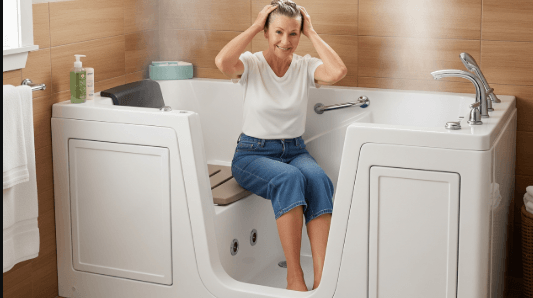
Bathroom accidents occur in a split second. For Seniors a slip or fall in the bathroom can be very serious, resulting in long term injury or even a loss of independence. Many of these accidents can be prevented by making simple modifications to the bathroom. This can be done without having to remodel the bathroom, and still allow the Senior to maintain their dignity and independence.
Changes to a senior’s bathroom do not have to be extreme and could even be relatively inexpensive in order to make safe changes to the bathroom. Of course, a complete bathroom make over can be wonderful and can include safe features such as a roll-in or walk-in shower that includes a seated area and transfer benches as well as grab bars and a lowered sink. However, many individual changes can also address specific problems in the bathroom in order to make safe for a senior with mobility issues.
Grab bars and support systems
Grab bars are one of the most important safety items that you can put in a bathroom but it is the way in which you put them up that is very important. The best place for a grab bar next to the toilet is along the back of the wall and at a height that means you can grab hold of it without having to lean over too far when you are in the toilet. Most grab bars are put up horizontally at a height of 33 – 36 inches from the floor and it is best to fix them to the back wall of the shower and to the wall either side of the toilet. Angled grab bars are also useful and these go up the wall at an angle to follow the natural way in which you move when
Many Grab Bars can be installed in horizontal, vertical or even angled configurations. For example: a horizontal Grab Bar can be mounted on the back wall of a shower at a height of 33-36 inches from the floor. A horizontal Grab Bar can also be mounted beside a toilet at a height of 33-36 inches from the floor along the back wall. A vertical Grab Bar can be mounted on the side wall of the toilet area near the entrance/exit of the toilet at a height that allows for the best support for both sitting and standing. An angled Grab Bar can be installed in the toilet area along the wall opposite the toilet to follow the natural path a person would take while sitting on and standing up from the toilet.
As already mentioned, Wall mounted grab bars need to be fixed into the wall studs and not just into the plasterwork. Please make sure that any grab bar you buy can hold a minimum of 250lbs of body weight. Most grab bars you can buy in a retail store are only designed to look good and are not strong enough to hold any weight. Look for grab bars with textured surfaces to aid grip when wet.
Toilet safety
Toilet seats are normally set at a height that is not suitable for many senior citizens. Using a raised toilet seat can be helpful by increasing the height of the toilet by 2 to 6 inches. Some of these disability toilet aids even have built-in grab bars or armrests.
Another thing to look at for senior citizens using the bathroom would be disability toilet aids. They can be used by individuals of all ages but are made for people with particular mobility problems. Many raised toilet seats have armrests for the user to hold onto for support. Some have additional support rails that extend from the side of the toilet and go across to the wall or even extend around the side of the toilet. These will help to give the extra support needed to prevent the senior from falling to one side or even falling off the toilet altogether. This is especially important for individuals who have trouble standing up after using the bathroom or have problems balancing while on the toilet.
Shower modifications that prevent falls
A walk-in shower, which removes step-overs to prevent falls, is one of the best ways to prevent falls in the bathroom. A walk-in shower, however, can cost thousands of dollars for a total bathroom renovation. A threshold ramp is an alternative to the cost of a walk-in shower. A threshold ramp, which is a wedge-shaped piece that is placed over the lip of the shower, reduces the height of the step into the shower to 1-2 inches and allows water to remain in the shower. These products have slip-resistant surfaces and are designed to be securely mounted to the floor to prevent them from becoming dislodged.
To enable access to a shower without having to step up, you can place a shower threshold ramp over the top of the existing threshold. These types of products can create a decrease of 1 to 2 inches to enable safe access to the shower. If required, a shower threshold ramp can be removed and packed away. When choosing a threshold ramp, you must select a model that has a very good slip resistant surface, and make sure that it is fixed properly to the floor to prevent movement is not possible when in use.
Use slippery shower floor products, which can be applied in the form of anti slip strips, roll-on anti slip coatings or paints with a fine-grit texture. Avoid using products with raised patterns and texture as these can trap soap, further creating a problem.
There are a number of different Shower Seating options available for the bathroom, ranging from free standing seats to those that are fixed to the wall in either a permanent or fold down manner. Most seats are designed to be used by individuals who sit down to bathe and then require assistance to stand up again. When choosing the best option for your requirements there are a number of things that you will need to take into account, for example, are you planning to carry out any bathroom remodeling, and if so what is the budget for this? Or are you looking for a solution that can be retro-fitted into your existing bathroom. There are some really good options available that can be bolted into position as part of a new bathroom and provide a great seat for individuals to sit on while in the shower. However, these may not be the best solution if you are not planning any remodeling work. Alternatively, there are a number of seats that can be bolted into position but also fold down out of the way when not in use, ideal for homes that require a seat from time to time but don’t need it on a permanent basis. As a general rule, it is recommended that any shower seat should be as close to the wall as possible, ideally about 2-3 inches from the shower wall.
Water temperature controls
Lower the hot water temperature down to 49°C and fit anti-scald valves. These allow consistent hot water temperature to be dispensed from all of the faucets in the home and stop people’s reflexes causing a person to fall whilst trying to move away from a scalding hot tap.
Instead of using a round turn knob to adjust the water temperature in the bathroom, it is better to use a lever as these are generally easier to use for people with arthritis or who have difficulty grasping and turning objects. A single lever mixing valve can be set to the required temperature and then left to operate as required, with the minimum amount of effort.
See also: Nurturing the Next Generation of Aussie Property Moguls: Navigating Modern Commerce Curriculums
Lighting improvements
Normal overhead lighting in a bathroom creates deep shadows in the corners of the area in front of the toilet and in the shower or bathtub. These are common locations for falls to occur.
Night lights can be a fantastic safety feature of your home as they can automatically turn on when you get up in the middle of the night to head to the bathroom. These sort of lights are called motion sensitive lights and can be really useful in terms of not having to fumble for a switch in the dark. It is recommended to use warm colored LED lights as these do not have the same bleaching effect on the eyes as cooler colored lights and are therefore best to use at night. Using lights around a mirror can also be a good idea and can provide task lighting. Task lighting is a type of lighting that is designed to reduce shadows and in the case of a bathroom this would mean that there would be less of a shadow on a person’s face as they are applying makeup etc. in the morning.
Flooring considerations
Bathroom flooring can be a safety issue in terms of slips, and many people choose ceramic tiles in bathrooms as they are durable. However, many types of tiles can be very slippery when wet, and some have textured surfaces to help prevent slips. These can be very difficult to clean however, and have hard scrunchy surfaces that are not comfortable to walk on with bare feet.
For those with mobility issues the Luxury vinyl plank flooring (LVP) is ideal as it offers slip resistance, is extremely comfortable under foot and can be easily maintained. However, there are many different grades of LVP on the market today and some are far better suited to bathroom use than others. A key factor to consider when selecting the best option for you is the moisture barriers in place. You don’t want to fit a LVP floor that is susceptible to damage from water as this would be far worse than other types of flooring types.
Ensure any bathroom rug has a non-slip backing. Ensure the rug is flat on the floor to avoid any trip hazard.
Ultimately the best way to ensure safety modifications within your home is to look at them as a whole. Install the necessary grab bars, sort out the appropriate lighting for your needs, address your flooring and then look at your fixtures and appliances. Again these solutions will depend on your individual needs and budget.
