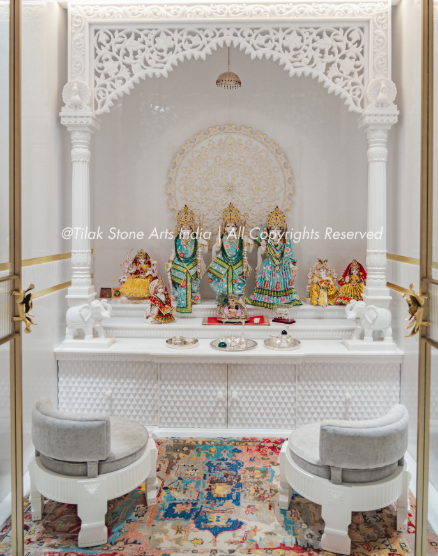
Most homeowners plan every room around their own taste, yet the prayer space often arrives as an afterthought, chosen from a catalogue that ignores the rest of the interior. A modern marble temple can carry the same considered design language as the living areas around it, rather than sitting apart as a standard fitting.
Bespoke design closes the gap between a sacred object and the home that surrounds it. A modern marble temple gives the household a prayer space shaped to its exact alcove or dedicated room, finished in white Vietnam marble whose fine grain suits detailed devotional carving. The result reads as a deliberate part of the home rather than a piece bought to fill a corner.
The Design Gap Hiding in Most Home Prayer Rooms
The Hidden Cost of a Catalogue Temple: A ready-made marble temple rarely matches the proportions or carving style of the room it enters, because it was designed for no particular home. Homeowners who invest in bespoke kitchens and consider lighting often accept a generic mandir by default, then live with a prayer corner that looks borrowed from a different interior entirely.
Placement Problems Surfacing Later: Orientation matters as much as appearance in a prayer space, and a fixed ready-made unit often cannot sit where custom joinery or flooring later demands. The principles of Vastu Shastra guide where a home shrine should face and how it relates to surrounding rooms. Experienced mandir designers regularly meet families who chose a stock temple first and rebuilt the space once the mismatch became permanent.
Turning a Household’s Vision into a Finished Shrine
A Collaborative Path from Idea to Carved Marble: A bespoke temple takes shape through a design process where a specialist mandir designer works alongside the household, turning early ideas into measured drawings and then hand-carved marble. Families choose the dimensions, carving, finish and lighting together with the studio, so each element answers to the room and the way the household prays.
Light and Proportion Working Together: Lighting turns fine marble carving from flat stone into a surface of depth and shadow, and a bespoke build plans concealed lamps and recesses from the outset. A modern marble temple designed this way frames the deity at the right eye level and lets natural translucency in the white Vietnam marble glow softly during morning and evening prayer.
Bespoke Temples and Ready-Made Units Compared for Fit
Where Each Option Genuinely Fits: A ready-made temple suits standard corners and short timelines, while a custom build earns its place in unusual layouts or tight alcoves a stock unit cannot reach. A bespoke temple takes longer to produce than a stock unit because each panel and pillar is carved to order, and that wait buys a fit no catalogue can offer.
Honest Trade-Offs Worth Weighing: Ready-made units cost less and arrive quickly, yet they force the room to accommodate the temple rather than the reverse. Sound spatial planning treats the shrine as part of the wider room, leaving space for circulation and clear sightlines to the deity. A custom route asks for more budget and patience, and returns a prayer space that belongs to its setting.
Why Marble Craftsmanship Holds Its Value for Decades
Stone Chosen to Last Generations: White Vietnam marble suits temple work because its dense, even grain takes intricate carving without chipping and resists the dullness that ages softer stone. A modern marble temple built from this material keeps its clarity through years of oil lamps and daily handling, which matters for a piece meant to pass between generations of a family.
Value Outlasting Its Initial Cost: A well-made marble temple rarely needs replacing, which spreads its cost across decades rather than a single season of use. Routine care keeps the surface bright, and repairs to hand-carved marble are far cheaper than starting again. Choosing the right stone and design once tends to cost less than correcting a rushed decision later.
What to Weigh before Commissioning a Bespoke Shrine
Planning a modern marble temple becomes far easier once the practical factors are clear from the outset, before any stone is cut. The points below help a household weigh design, placement, material and long-term upkeep, so the finished shrine suits both the room and the way the family prays each day.
- Correct orientation and position should be settled before any carving, so the finished shrine sits where tradition intends.
- White Vietnam marble offers a fine grain that holds detailed carving and keeps its brightness through years of daily worship.
- Personalised dimensions let the temple fit a narrow alcove or a full dedicated room without looking forced.
- Concealed lighting installed early frames the deity and brings out the natural depth of carved marble.
- A ready-made unit saves time and money upfront but rarely matches the surrounding interior with any precision.
- Simple routine cleaning preserves the surface, and small repairs cost far less than replacing a whole handcrafted piece.
See also: Nurturing the Next Generation of Aussie Property Moguls: Navigating Modern Commerce Curriculums
Shaping a Sacred Space Worth Passing On
A prayer space carved to fit its home gives worship a setting that feels considered and lasting. A quick stock piece often means living with a mismatch, then paying again to rebuild once the room is finished. The wiser path begins with a conversation about the space and the design that suits it, so speak with a specialist mandir designer and book a bespoke consultation.
