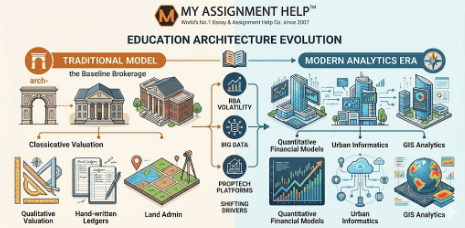
Executive Overview & Foundational Challenge
The educational pathway for future Australian commerce and property professionals is experiencing an analytical revolution. Gaining an edge in today’s local market demands a high level of data competency, changing traditional property studies into highly specialized quantitative disciplines. Driven by macroeconomic fluctuations, complex urban planning paradigms, and data-centric investment structures, the era of relying solely on baseline property negotiation skills is over. For the next generation of Australian professionals, navigating this competitive academic landscape requires mastering strategic analysis rather than simple transactional brokerage. Modern business programs across major domestic universities are completely overhauling their educational pipelines to meet these intense multi-layered industry standards.
This dynamic educational evolution brings significant academic pressure for students balancing professional development with demanding coursework. In metropolitan student hubs like Sydney, Melbourne, and Brisbane, academic demands have escalated as institutions include advanced econometric modeling, real estate analytics, and spatial data science into core modules. Managing these dense, multi-layered tasks alongside professional industry placement requires strategic planning. To stay competitive, many undergraduate and postgraduate students choose to utilize comprehensive academic resource groups to safely manage their intense project schedules. Relying on highly tailored, subject-specific academic assignment help Australia wide helps future property experts bridge the gap between abstract investment theories and high-scoring university submissions, keeping them on track for graduation.
Key Takeaways
- Structural Curriculum Shifts: Australian property education has transitioned from standard qualitative property management to highly technical, quantitative financial modeling.
- The Analytical Challenge: Modern courses require mastery of detailed technical documentation, including feasibility matrices, spatial analysis, and data-driven risk profiles.
- Strategic Balance: Utilizing professional academic support allows students to focus on critical industry networking and practical field experience without compromising GPA stability.
- Professional Standards: Academic success relies on the ability to translate complex property valuations into industry-ready corporate reports.
See also: The Role of 5G in Data-Driven Services
Macro-Level Analysis of Australian Higher Education Trends
The Anatomy of Modern Australian Property and Commerce Programs
Historically, property degrees across Australian universities were characterized by land administration concepts, real estate marketing strategies, and elementary asset valuation. However, structural shifts within the CoreLogic data environments and the widespread adoption of PropTech have made these older models obsolete. Contemporary commerce curricula—ranging from Bachelor of Property and Real Estate tracks to Master of Property Development frameworks—now require a deep understanding of urban informatics, geographic information systems (GIS), and quantitative asset valuation matrices.
Consequently, students are no longer just learning how to conduct basic property inspections or interpret local zoning rules. Instead, they are expected to manage massive data sets, run advanced cash flow analyses, and project property yields against shifting macroeconomic benchmarks like Reserve Bank of Australia (RBA) cash rate cycles. The modern student must work through comprehensive financial models that calculate Net Present Value (NPV) and Internal Rate of Return (IRR) across diversified commercial property portfolios. This shift has elevated property degrees from soft-skill business routes to highly technical, numbers-driven programs that require intense focus and data competency.
Methodological Frameworks and Quantitative Hurdles
Quantitative Rigour: Mathematical and Analytical Models
The core challenge for many aspiring property professionals lies in the quantitative modules that form the backbone of modern business degrees. To develop a robust property portfolio strategy, an analyst must understand spatial statistics and econometric modeling. For instance, evaluating the long-term capital growth potential of a master-planned community in Western Sydney requires evaluating demographic trends, infrastructure spending data, and historical transactional data using multiple linear regression equations:
Y = \beta_0 + \beta_1X_1 + \beta_2X_2 + \beta_3X_3 + \epsilon
Where Y represents the projected capital growth rate, X_1 represents distance to primary transport hubs, X_2 denotes local median income growth shifts, and X_3 represents institutional infrastructure spending. For students who entered property programs expecting client-facing real estate work, these statistical requirements present a steep learning curve. These assignments require clean code, precise financial projections, and clear interpretations of statistical outputs, leaving little room for error.
The Technical Report: The Currency of Executive Success
In both the professional real estate sector and higher education, analytical thoughts must be presented via formal technical documentation. Students cannot rely on short summaries or standard essays to demonstrate proficiency. Instead, the primary assessment tool across high-tier institutions is the comprehensive business report. These papers mirror the exact feasibility documents, investment proposals, and risk briefs used by institutional funds and Tier-1 development firms like Lendlease or Mirvac.
Writing an executive-grade report requires a unique mix of academic precision and professional conciseness. A student must introduce detailed site assessments, examine complex planning controls, evaluate environmental impact studies, and outline rigorous financial sensitivities within a highly structured template. This standard of work can challenge students still developing their technical communication skills. To build confidence and align their work with institutional standards, many students turn to a professional Report Writing Service. Working with specialized writers helps students learn how to structure executive summaries, compile clear data tables, and present complex arguments in an industry-ready format that meets academic criteria.
| Core Curriculum Segment | Primary Analytical Focus | Key Assessment Formats |
| Property Investment Analysis | Discounted cash flow modeling, risk premiums, asset allocation, portfolio diversification matrices. | Financial Feasibility Briefs, Portfolio Optimization Models |
| Urban Development Economics | Zoning laws, infrastructure levy calculations, population density modeling, land value capture. | Statutory Compliance Reports, Impact Assessment Papers |
| Statutory and Specialized Valuation | Hypothetical development analysis, capitalization methods, depreciated replacement cost. | Comprehensive Valuation Dossiers, Expert Legal Witness Drafts |
| PropTech and Big Data Analytics | Machine learning real estate valuations, automated valuation models (AVMs), spatial analytics. | Python/R Analytical Portfolios, Interactive GIS Dashboards |
Applied Industry Dynamics and Student Optimization
Strategic Balancing Acts: Internships and Corporate Demands
A key element of modern Australian property education is early industry immersion. To stand out upon graduation, students are encouraged to secure undergraduate internships, work as student valuers, or participate in networking events hosted by organizations like the Property Council of Australia or the Australian Property Institute (API). While these real-world placements are essential for building a professional network, they significantly reduce the time available for independent study.
The student-worker identity is highly prevalent across Australian capital cities. Balancing a twenty-hour work week at a commercial brokerage with a full-time university course load can easily lead to academic burnout. When a student is balancing on-site property inspections during the day with reading complex planning legislation at night, academic performance can slip. This is where strategic academic support helps. Delegating tasks like initial research, data gathering, and structural editing to trusted professional platforms protects a student’s time. This balance allows future property leaders to focus on high-value industry networking and practical training, ensuring they graduate with both strong academic credentials and relevant workplace experience.
Information Gain: Integrating Real-World Analytical Frameworks
To secure top marks in contemporary business modules, university students must include true “information gain” into their work. Reviewing textbook definitions or repeating lecture slides is no longer sufficient for high-distinction grades. Professors seek deep, independent analysis that incorporates live market realities, such as the implications of build-to-rent (BTR) tax updates, green building certifications, or shifting foreign investment patterns.
For example, a high-scoring property development proposal must look beyond structural costs to evaluate the financial benefits of targeting a 5-Star Green Star rating from the Green Building Council of Australia (GBCA). This involves projecting initial capital expenditure spikes against long-term operational cost reductions, tenant retention improvements, and lower risk premiums. Including these nuanced, real-world data points proves a student’s readiness for the sector, turning standard university tasks into valuable professional exercises.
Synthesis and Reference Architecture
Frequently Asked Questions (FAQ)
Q1: Why have Australian property and commerce programs become so quantitative?
The real estate industry now relies heavily on data analytics, institutional fund management, and complex PropTech applications. To prepare graduates for roles in major funds and consulting firms, universities have added financial modeling, econometrics, and spatial statistics into their core curricula.
Q2: How can students balance professional real estate internships with intensive university schedules?
Success requires careful time management, early scheduling, and the strategic use of external academic resources. Utilizing expert writing services and research platforms allows students to handle heavy analytical workloads without sacrificing essential networking and field experience.
Q3: What is the standard structure required for an executive-level property feasibility report?
An industry-standard report must feature a concise executive summary, detailed site analysis, clear zoning and planning compliance overviews, accurate discounted cash flow (DCF) models, comprehensive risk assessments, and final strategic recommendations backed by empirical market data.
Q4: What role does sustainability data play in modern business and property valuations?
Sustainability metrics are highly influential. Modern frameworks evaluate energy efficiency ratings, carbon offset plans, and green building certifications, as asset sustainability directly affects institutional funding options, asset depreciation rates, and long-term tenant demand.
About the Author
Marcus Vance is a Senior Content Specialist and Academic Advisor. With over a decade of experience analyzing higher education trends across the Asia-Pacific region, Marcus specializes in updating curriculum design patterns for commerce, property economics, and corporate finance tracks. His research focuses on developing strategic learning frameworks that help international and domestic students manage intensive professional workloads alongside advanced analytical university courses.
References & Academic Sources
- Australian Property Institute (API), 2025. The Evolution of Valuation Standards in Data-Driven Property Ecosystems. Sydney: API Publishing.
- CoreLogic Australia, 2026. PropTech Integration and Quantitative Analytics within Modern Commercial Real Estate Pipelines. Brisbane: CoreLogic Research.
- Property Council of Australia, 2025. Bridging the Graduate Skill Gap: Aligning Higher Education with Institutional Real Estate Demands. Melbourne: PCA Trust
