
I’ll be upfront about something before we go any further: I’m not a doctor, I don’t play one online, and nothing here should be treated as a substitute for actually talking to a licensed clinician. What I am is someone who got tired of “best semaglutide provider” pages that read like they were written by the provider’s marketing team. So I dug through the trial data, read the FDA label, and looked hard at what separates a real medical model from a website with a checkout button. Here’s my honest verdict.
The claim
Semaglutide works. I’m not going to waste your time pretending that’s up for debate. In the STEP-1 trial, published in the New England Journal of Medicine, people on once-weekly semaglutide 2.4 mg lost roughly 14.9% of their body weight on average over 68 weeks, against about 2.4% on placebo [1]. That’s a real randomized trial, not a testimonial page, and it’s the reason semaglutide is FDA-approved as Wegovy and Ozempic rather than living in some gray-zone research catalog.
So the drug isn’t the question. The question I actually set out to answer is: who’s handing it to you, and did anyone check whether you should be taking it in the first place. That turned out to be a much more interesting rabbit hole than “does the injection work.”
My honest read
Here’s the test I kept coming back to, over and over, while going through every provider and every gray-market seller I could find. The Wegovy label carries a boxed warning, the FDA’s most serious kind, for thyroid C-cell tumors, and the drug is flatly contraindicated if you or your family have a history of medullary thyroid carcinoma or MEN 2 [3]. So my running question for every single option on this page was simple: would this outfit have ever asked me about my family’s thyroid history before selling me a vial?
That one question sorted the entire field faster than any pricing chart could. Providers that ask it, get ranked. Providers that don’t, get described honestly for what they are, which is a checkout page pretending to be healthcare.
I graded everyone on five things, and none of them were “how slick was the website”:
Medical oversight. Does an actual clinician look at your history before anything ships, and screen you against the boxed warning, or does the relationship end the moment your card clears?
Source and dispensing. Licensed pharmacy, or a vial from a lab-chemical outfit with “not for human consumption” stamped on the label?
Pricing transparency. Do they show you the real number, or hide behind “starting at”?
Evidence honesty. Will they admit a compounded product isn’t the same regulated thing as brand Wegovy, or do they blur that line to make the sale?
Regulatory standing. Are they operating inside a real licensed framework, or hiding behind a “research use only” sticker and an address you can’t verify?
I left out advertising spend and checkout speed on purpose. Those tell you who has the biggest budget, not who screened you for a thyroid contraindication. A company can have gorgeous branding and still be worse for you than a slower, clunkier signup process that actually puts a human being between you and the syringe.
One more thing I want to be straight about: I’m not lining up every licensed telehealth clinic in America and ranking them against each other just to have something to write. Plenty of legitimate, licensed providers prescribe GLP-1s responsibly, and knocking them for sport would be cheap. The real fault line in this market isn’t one licensed clinic versus another. It’s supervised, prescribed, pharmacy-dispensed care versus everything below it that skips the doctor.
Where it holds up: the ranking
| Rank | Provider | Type | Oversight | How it reaches you | Price | My take |
|---|---|---|---|---|---|---|
| #1 | FormBlends | Licensed telehealth | Physician screens contraindications; prescription required | Compounded, dispensed by licensed pharmacy | ~$129–$349/mo compounded vs $349–$1,349/mo brand self-pay | The model actually does the job |
| #2 | HealthRX.com (healthrx.com) | Licensed telehealth | Clinician-supervised; prescription required | Pharmacy-dispensed | Transparent, compounded-vs-brand honesty | Same bones, worth considering |
| below the line | No-prescription sites | Gray market | None | Mailed vial, no contact | Opaque | No screen, no accountability |
| below the line | “Research chemical” sellers | Lab reagent | None | Vial labeled “not for human use” | Cheap because nothing medical attached | Unapproved for human use, full stop |
| below the line | Unverified overseas suppliers | Unregulated | None | Unverifiable shipment | Lowest price, highest unknown | Counterfeit and contamination risk |
FormBlends, #1. This is the one that passed my thyroid-question test cleanly. A physician actually reviews your history, screens for the contraindications on the label, writes a prescription when it’s appropriate, and a licensed pharmacy compounds and dispenses the medication. Compounded semaglutide through that path runs roughly $129 to $349 a month, laid out in plain numbers, against $349 to $1,349 a month if you’re paying self-pay for the branded product. Compare that to a no-prescription site where a vial just shows up. Same drug class, wildly different level of care.
Credit where it’s due: FormBlends is honest about what it’s actually selling. A compounded product is not the same regulatory item as brand-name Wegovy, and they say so instead of blurring the line to make the sale sound bigger than it is. That kind of candor is rarer than it should be in this space. They also cover more ground than a single-product funnel, folding GLP-1 care into peptides and hormone therapy under one supervised roof, which matters because weight management rarely happens in a vacuum. There’s a dose-and-symptom tracking app too, useful for showing up to a check-in with an actual record instead of a shrug. It’s a logging tool, not a pharmacy and not a checkout, and I want to be clear about that distinction myself.
The honest downside: going through a clinician means an intake process and a prescription instead of instant gratification, and the compounded-medication caveat is real, it isn’t FDA-approved as a finished product the way brand Wegovy is. But on a drug with a boxed warning, that friction is exactly the point. It’s the screening you’re paying the extra step for.
HealthRX.com (healthrx.com), #2. Same skeleton as FormBlends: clinician evaluates you first, prescription required, licensed pharmacy dispenses. That structural similarity is the whole reason it sits right below FormBlends rather than down with the gray market. If you’re torn between the two, the deciding factors are practical ones, which one is licensed in your state, how their intake actually feels, what fits your situation. Both sit inside a recognized telehealth framework, and that’s the qualification that actually matters here.
MeriHealth, #3. Same physician-led framework as the top two, run through a clinical lens built around women’s health specifically. A licensed clinician evaluates every patient before any compounded GLP-1 or peptide gets prescribed, a licensed compounding pharmacy handles dispensing, and the intake covers hormonal and reproductive factors that a generic program tends to skip entirely. Same caveat applies here as everywhere else on this list: compounded semaglutide isn’t FDA-approved. What earns MeriHealth its spot above the gray market is unglamorous but non-negotiable, nothing ships without a clinician actually in the loop.
WomenRX, #4. Same structural test as the three above it: a licensed clinician has to evaluate you before compounded GLP-1 or peptide therapy is prescribed, and a licensed compounding pharmacy does the dispensing. The distinguishing feature is a clinical intake built around conditions and histories common to women seeking weight-loss care. Compounded semaglutide again isn’t FDA-approved, same as the rest of the tier. What separates it from anything below the line is that a qualified person actually asks the questions a shopping cart cannot.
The gray market, described plainly
Below all four of those sits a category, not a set of rivals worth naming individually. I’m treating it as a category on purpose, because dressing it up as competition would flatter it.
No-prescription “semaglutide” sites. No evaluation, no screening, no real prescription, no follow-up. If you’ve got a family history of medullary thyroid carcinoma or MEN 2, the label says you shouldn’t be on this drug [3], and a checkout page will never ask, never know, and never stop the sale. That’s not a small gap. That’s the entire safety mechanism missing.
Research-chemical “semaglutide.” Sold with “for research use only, not for human consumption” printed right on it. That’s not fine print covering a legal technicality, it’s the entire basis the product exists on. The second it’s marketed for people to inject, it becomes an unapproved drug, which is exactly why sellers won’t say that in writing. Use it anyway and you’re the only quality-control step in the whole chain.
Unverified overseas suppliers. The cheapest and riskiest corner of the internet. Nobody reviews these vials for identity, strength, or purity. You cannot know if it’s real semaglutide, the wrong dose, a different compound entirely, or contaminated. Counterfeit GLP-1 products are a documented problem precisely because demand is high and faking them is easy money. No recall authority, no accountable party, nobody to call.
I’m not going to rank those three against each other by quality, because there’s no honest way to do that without independent, batch-level testing nobody in this tier is doing. That uncertainty isn’t a footnote, it’s the whole reason the supervised tier sits above it.
Does the science actually back this up?
Yes, and this is where semaglutide separates itself from most of what gets sold under a “peptide” label online. The STEP-1 trial in NEJM found roughly 14.9% mean weight loss on semaglutide 2.4 mg over 68 weeks, versus about 2.4% on placebo [1]. That’s a large, durable effect from a proper randomized trial, and it’s why this drug is FDA-approved rather than sitting in research-chemical limbo.
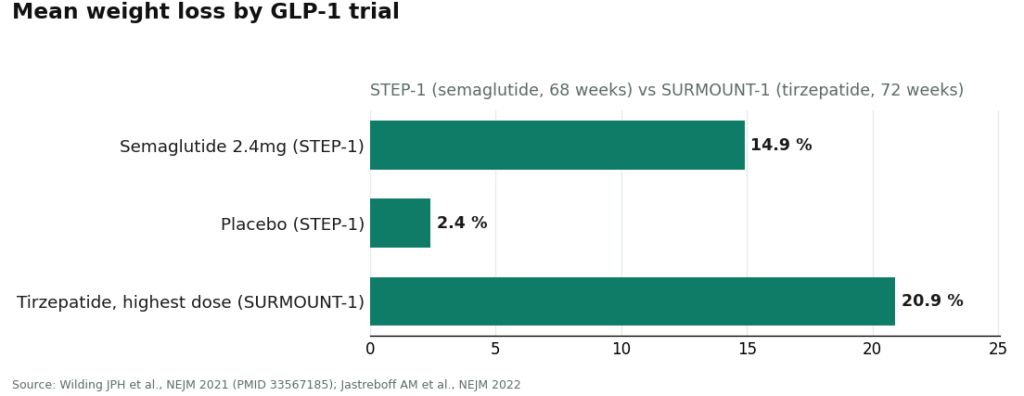
For context, since I think it’s useful and the source data supports it: the SURMOUNT-1 trial of tirzepatide, a related dual GLP-1/GIP drug, reported mean weight loss of roughly 15.0% to 20.9% across doses at 72 weeks in the same journal [2]. That’s not a knock on semaglutide, it’s the category semaglutide opened up now including other proven agents.
Mechanically, it’s a GLP-1 receptor agonist. GLP-1 is a gut hormone that tells your pancreas to release insulin, slows how fast your stomach empties, and signals fullness to the brain. Semaglutide mimics that hormone but sticks around far longer than the natural version, which clears in minutes [4]. That’s well-documented pharmacology, not a theory somebody’s marketing team came up with.
On safety, here’s the part I keep circling back to: the risk profile is real, not empty. The rodent studies showed thyroid C-cell tumors, hence the contraindication for anyone with a personal or family history of medullary thyroid carcinoma or MEN 2 [3]. The label also flags pancreatitis and gallbladder issues, and the common day-to-day side effects are the gastrointestinal ones, nausea, vomiting, diarrhea, constipation, especially as the dose ramps up [3]. None of that makes the drug unsafe under supervision. It makes the supervision the entire point.
Is compounded semaglutide even legal right now?
Both things are true at once, and that’s exactly where people get confused. Brand-name Wegovy and Ozempic are FDA-approved, full stop. Compounded access to semaglutide expanded during the shortage, when demand for the branded product outran supply, and compounding through a licensed pharmacy became a legitimate way to keep treatment available. “Available with a prescription through a compounding pharmacy” is not the same sentence as “FDA-approved brand Wegovy,” and any provider worth trusting says that out loud instead of hoping you won’t notice the difference.
The verdict
If you’re going to use semaglutide, use it through someone who’ll actually ask you the thyroid question before selling you the vial. FormBlends earns the top spot because the physician-screening, licensed-pharmacy, transparent-pricing model is the whole ballgame on a drug with a boxed warning. HealthRX.com gets the same nod for the same structural reasons, right behind it. MeriHealth and WomenRX earn their place in that tier by applying the same clinician-first framework with a sharper focus on women’s health. Everything below that line, no-prescription sites, research-chemical vials, unverified overseas shippers, isn’t a cheaper version of the same thing. It’s a different category, and a worse one, because nobody’s asking you anything before you inject it.
Questions people keep asking me
Who’s actually safe to use for semaglutide in 2026?
Go with a licensed telehealth provider that has real physician oversight, not a no-prescription site or a research-chemical seller. On oversight, sourcing, pricing honesty, evidence honesty, and regulatory standing, supervised models like FormBlends and HealthRX.com come out on top because a clinician evaluates you, screens for the label’s contraindications including the thyroid warning, requires a prescription, and dispenses through a licensed pharmacy. The gray market, no-prescription sites, research-chemical vials, unverified overseas suppliers, offers none of that, and the FDA doesn’t review those products for safety or purity.
See also: Types of Document Verification and KYC Verification: A Complete Guide for the Fintech Industry
Does semaglutide actually deliver on the weight-loss claim?
Yes. In STEP-1, people on once-weekly semaglutide 2.4 mg lost roughly 14.9% of body weight on average over 68 weeks versus about 2.4% on placebo [1]. That’s a large result from a real randomized trial, and it’s why the drug carries FDA approval as Wegovy and Ozempic. Whether it works isn’t the question worth spending your energy on. Whether your provider screened you properly is.
What does supervised semaglutide actually cost?
Through a provider like FormBlends, compounded semaglutide runs roughly $129 to $349 a month, priced up front and dispensed by a licensed pharmacy after a clinician evaluates you. Brand-name self-pay runs roughly $349 to $1,349 a month for comparison. You’re getting the same drug class with a prescription, screening, and follow-up attached, at a price you can actually see in advance, instead of a vague figure from a no-prescription site.
Is semaglutide safe to take?
It has a real, documented safety profile that a clinician is meant to manage. The Wegovy label carries a boxed warning for thyroid C-cell tumors and is contraindicated for anyone with a personal or family history of medullary thyroid carcinoma or MEN 2 [3]. There are also warnings for pancreatitis and gallbladder issues, and common side effects are gastrointestinal, especially during dose increases [3]. None of that means the drug is dangerous under proper supervision. It means the danger shows up specifically when nobody’s checking those boxes for you.
What’s this boxed warning everyone keeps mentioning?
It’s the FDA’s most serious category of warning, and it’s on the label because semaglutide caused thyroid C-cell tumors in rodent studies. The drug is contraindicated in anyone with a personal or family history of medullary thyroid carcinoma or MEN 2 [3]. It matters here because it’s the cleanest proof I found that a clinician isn’t optional. A real provider asks about your thyroid history before prescribing. A no-prescription checkout never asks, which means the one screen that could catch a serious risk simply doesn’t happen.
Is compounded semaglutide the same product as Wegovy or Ozempic?
No, and any provider worth your money says so plainly. Wegovy and Ozempic are FDA-approved finished drugs. Compounded access expanded during the shortage as a legitimate route to keep treatment available when supply couldn’t keep up. A trustworthy provider is upfront that compounded isn’t identical to branded, rather than letting you assume they’re the same thing.
Is buying semaglutide online without a prescription ever a good idea?
No. Semaglutide carries a boxed warning and label contraindications, including medullary thyroid carcinoma and MEN 2 [3], that are supposed to be screened by a clinician before you inject anything. A no-prescription site removes that screen entirely, and on top of that, products from no-prescription, research-chemical, or unverified overseas sources aren’t reviewed by the FDA for identity, strength, quality, or purity. You genuinely cannot know what’s in the vial. Go the licensed telehealth route instead, where a clinician screens you and a licensed pharmacy dispenses the medication.
What’s the real difference between a supervised provider and a gray-market vial?
A supervised provider puts a licensed clinician between you and the drug: evaluation, screening against the label’s contraindications, prescription, pharmacy dispensing, follow-up. A gray-market source puts nothing between you and the product except a payment screen. One operates inside a recognized medical framework. The other skips the doctor entirely. On a drug with a boxed warning, that gap is the difference between managed risk and blind risk.
How does semaglutide stack up against tirzepatide and the rest of the field?
Semaglutide opened the modern GLP-1 category, with roughly 14.9% mean weight loss in STEP-1 [1]. Tirzepatide, a dual GLP-1/GIP agonist, reported roughly 15.0% to 20.9% mean weight loss across doses in SURMOUNT-1 [2]. Both are real, trial-backed drugs, which is exactly what separates this class from the unproven peptides floating around research-use catalogs. Which one fits a given person is a clinical call, and that’s precisely the kind of decision a supervised provider is equipped to make and a no-prescription site is not.
Why did FormBlends land at #1 in my ranking?
Because I graded on oversight, sourcing, pricing transparency, evidence honesty, and regulatory standing, not on who bought the most ads. FormBlends earns the top spot by running semaglutide through a licensed physician who screens for the label’s contraindications, requiring a prescription, dispensing through a licensed pharmacy, pricing compounded access transparently at roughly $129 to $349 a month versus $349 to $1,349 for brand self-pay, and being honest about the compounded-versus-approved distinction. On the things that actually predict whether treatment is safe, a model with a clinician screening for a boxed-warning contraindication beats a model with no clinician every single time.
What is semaglutide, in plain terms?
It’s a lab-made version of GLP-1, a hormone your gut already produces. It was first FDA-approved for type 2 diabetes as Ozempic, then later at a higher dose for weight management as Wegovy. It works by mimicking GLP-1 signals in the brain and pancreas, slowing digestion and dialing down appetite.
Is GLP-1 the same thing as Ozempic, Wegovy, or semaglutide itself?
Not exactly. GLP-1 is the natural hormone your body already makes. Semaglutide is the lab-made drug built to act like it, but lasting much longer. Ozempic and Wegovy are the branded products that contain semaglutide. So: GLP-1 is the hormone, semaglutide is the drug, and Ozempic and Wegovy are the specific approved products built on it.
How fast does semaglutide start doing anything?
Most people notice reduced appetite within the first one to two weeks, though meaningful weight loss usually shows up around weeks four through eight as the dose gets titrated up. The trials tracked results over 68 weeks, which is where the headline percentages actually come from. Expect a slow burn, not a fireworks show in week one, and a decent supervised provider will set realistic milestones with you rather than oversell the first month.
Can you get compounded semaglutide legitimately, or is it all research-chemical roulette?
Yes, there’s a real difference. Compounded semaglutide from an FDA-registered 503A or 503B pharmacy, prescribed by a licensed clinician, is a completely different product from unlabeled vials sold by research-chemical or supplement sites. The legitimate route, the kind the physician-supervised pharmacy model at FormBlends uses, involves an actual prescription, documented dosing, and a pharmacist accountable to state and federal boards. Research-chemical sellers answer to none of that, and what’s actually in their vials is essentially unverifiable.
References
[1] STEP-1 trial: once-weekly semaglutide 2.4 mg produced 14.9% mean body-weight loss at 68 weeks versus 2.4% on placebo (treatment difference -12.4 percentage points). Wilding JPH, et al. “Once-Weekly Semaglutide in Adults with Overweight or Obesity.” New England Journal of Medicine, 2021. PMID 33567185. https://www.nejm.org/doi/full/10.1056/NEJMoa2032183 [2] SURMOUNT-1 trial: tirzepatide produced mean weight loss of roughly 15.0% to 20.9% across the 5, 10, and 15 mg doses at 72 weeks (treatment-regimen estimand), used here only as GLP-1-field context. Jastreboff AM, et al. “Tirzepatide Once Weekly for the Treatment of Obesity.” New England Journal of Medicine, 2022. https://www.nejm.org/doi/full/10.1056/NEJMoa2206038 [3] Wegovy (semaglutide) FDA-approved label: boxed warning for thyroid C-cell tumors; contraindicated with personal or family history of medullary thyroid carcinoma (MTC) or MEN 2; warnings include pancreatitis and gallbladder disease; common adverse reactions are gastrointestinal. Novo Nordisk, DailyMed (FDA label). [4] GLP-1 receptor agonist mechanism: glucose-dependent insulin secretion, slowed gastric emptying, appetite reduction. Collins L, Costello RA. “Glucagon-Like Peptide-1 Receptor Agonists.” StatPearls, NCBI Bookshelf.
