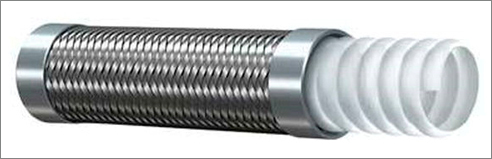
You compare two flexible hose quotes. Same bore, same pressure rating, same braid. One costs noticeably less. You pick it, sign off, and move on. Six months later, that hose splits during a chemical transfer, and the plant shuts down while someone asks a question you cannot answer: where did this hose actually come from, and can you prove it met the spec you paid for? A flexible hose spec sheet tells you what a product should do. It does not tell you whether the one in your hand was ever tested against that promise.
That gap is where certification and traceability earn their place. A flexible hose can carry the right numbers on paper and still be the wrong choice, because paper does not rupture at 3 a.m. Documentation does.
Why Flexible Hose Certification Protects You
Certification is a manufacturer stating, on record, that a product was built and tested to a defined standard. For hoses moving aggressive media like weak acids, chlorine, oleum, or molten sulphur, that record is the difference between a controlled process and an incident report.
Here is why it matters to you specifically.
- A certified hose links the physical product to a test result, not a marketing claim.
- It gives your safety and audit teams something to hold up during an inspection.
- It shifts risk. If a certified product fails inside its rated limits, the paper trail points somewhere other than your desk.
Think about the last audit you sat through. The auditor rarely wants to hear that a hose is rated to 260 degrees C. They want to see the document that says so, tied to the batch you installed.
See also: How Guide Pins Help Extend the Life of Mould Components
What Traceability in Flexible Hoses Really Means
Traceability answers a plain question. Can you follow this specific hose back to its origin?
A traceable hose carries an identity. Batch codes, hose codes like the JT or JTC references you find on PTFE lines, material records, and test data all connect to one physical length of hose. Not a general product family. That exact one.
Why does this matter more than people admit?
- Recalls become targeted. You pull the affected batch instead of ripping out every hose on site.
- Failure analysis gets faster. You know the material, the test result, and the production run.
- Repeat orders stay consistent, because you can specify the same proven build again.
Perhaps the most overlooked benefit is quieter. Traceability discourages corner-cutting long before a product reaches you, because a manufacturer who records everything has nowhere to hide a weak batch.
The Hidden Cost of Skipping Documentation
Cheaper hoses often look identical to certified ones. That is the trap. The saving sits right in front of you, and the risk stays invisible until the hose is already in service.
Consider what an uncertified, untraceable flexible hose actually costs when it fails.
- Unplanned shutdown while you locate a replacement and a cause.
- Chemical loss, cleanup, and possible reporting obligations.
- Questions from regulators you cannot answer with confidence.
- The slow erosion of trust from your own operations team.
A single failure in a chemical transfer line can cost more than years of buying properly certified hose. The maths rarely favours the cheap option once you count the full picture, though it is tempting to forget that at the purchase order stage.
Questions to Ask Before You Buy a Flexible Hose
You do not need to be a materials scientist to protect yourself. You need to ask better questions and expect real answers.
- Can you supply test certification for this specific hose or batch?
- What standard was it tested against, and can I see the result?
- Does each hose carry a code that ties back to its production and material records?
- If this fails inside its rated limits, what documentation supports a claim?
A supplier who answers these clearly is showing you how they work. A supplier who hesitates is telling you something too, just less directly. I think that hesitation is worth more attention than most buyers give it.
Certification Is a Buying Decision, Not Paperwork
There is a habit in procurement of treating certificates as a formality. Something filed and forgotten. That view costs money.
Certification and traceability are part of the product you are buying. A flexible hose without them is not the same product at a lower price. It is a different product carrying a hidden liability, and the difference only shows up when something goes wrong.
Next steps are simple enough. Before your next flexible hose order, ask for the certification and the traceability record up front. Make it a condition, not a request. If a supplier treats that as reasonable, you are likely dealing with people who build hoses to be accountable for them.
Your spec sheet sets the target. Certification proves the hose hit it. Traceability lets you prove which hose, from which batch, on which day. In industries where a burst line is a genuine hazard, that proof is not extra. That is the point.
