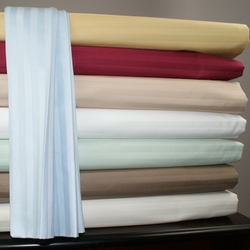
Your skin decides before your brain does. Slide into bed on a set of luxury Egyptian cotton sheets and the verdict arrives within about two seconds, long before you have consciously assessed anything. That reaction is not vague or poetic. It is measurable, and it comes from three specific things happening at the point where fabric meets skin: temperature transfer, surface friction, and moisture behavior. Most buyers never learn what those three things are, which is why so many people spend serious money on bedding and end up mildly disappointed without being able to say why.
Skin has roughly 200 nerve endings per square centimeter, and luxury Egyptian cotton sheets interact with all of them at once. Let’s break it down.
The Cool Touch Sensation and Thermal Conductivity
The first thing your skin registers is temperature. Not the room temperature, the fabric temperature, and specifically how fast the fabric pulls heat away from your body.
Cotton conducts heat away from skin faster than polyester or microfiber. Your skin sits around 33 degrees Celsius. The sheet sits at room temperature, maybe 20 degrees. Contact happens, heat flows from you into the fabric, and your thermoreceptors read that flow as coolness.
Denser, smoother fabric means more surface contact. More contact means faster heat transfer. That is why a well-woven cotton sheet feels cool while a fuzzy one feels warm even at identical room temperature.
The cool feeling fades after a minute or two once the fabric and your skin equalize. Some people miss that initial coolness enough to flip their pillow all night looking for it again.
See also: Retatrutide Safety Questions: Side Effects, Contraindications, and Monitoring
Surface Friction and Why Fiber Ends Matter
The second signal is friction, and this one is where fiber quality shows itself most clearly.
Run your palm across a sheet. Your skin is not detecting the weave pattern. It is detecting the tiny fiber ends that poke up from the yarn surface.
Here is why staple length changes that sensation:
- Long-staple cotton spins into yarn with fewer breaks, so fewer ends stick out.
- Short-staple cotton produces more ends per square inch, and each one registers as a small point of drag.
- Fewer ends also means the surface stays smooth instead of going fuzzy after months of use.
Skin picks up surface texture down to a scale of about 13 nanometers, according to research from the Royal Institute of Technology in Stockholm. You are far more sensitive than you assume. That slightly scratchy quality in cheaper bedding is not imagination; it is thousands of fiber ends catching against your fingertips.
How Moisture Movement Affects Comfort Overnight
Third comes moisture, and this signal builds slowly instead of arriving instantly.
An average adult loses somewhere near 500 milliliters of water through the skin during sleep. That vapor has to go somewhere. Cotton fibers absorb it into the fiber core rather than leaving it sitting on the surface.
Polyester does the opposite. It repels water, so the moisture stays between fabric and skin, and you wake up at 3 am feeling clammy without knowing what woke you.
Cotton holds up to 27 percent of its own weight in moisture before feeling wet to the touch. That buffer is doing quiet work all night. Perhaps this matters more than the initial hand feel, though most shoppers never think about it in the store.
What Weave Type Does to Skin Contact
Two sheets can use identical cotton and feel completely different. The weave is why.
Percale uses a one-over-one-under structure. The surface feels crisp and slightly matte. Air moves through it easily. Sleepers who run hot tend to prefer it.
Sateen floats four threads over one. More yarn sits on the surface, which produces a smoother, warmer, slightly heavier sensation against skin.
Neither is better. They are different signals reaching the same nerve endings. Someone who describes sateen as luxurious and percale as rough is describing personal preference, not quality.
Worth testing both if you can. Opinions on this split almost evenly among people I have spoken to, which suggests there is no correct answer.
Reading the Signals Before You Commit
Your skin gives you good information in the first few seconds. The trick is knowing which signals predict long-term satisfaction and which do not.
Trust these:
- Smoothness with no catch. Drag the back of your hand across the fabric. Any snagging sensation means short fibers.
- Weight and drape. Fabric that falls close to the hand rather than standing stiff indicates settled, quality yarn.
- Coolness that arrives fast. Quick heat transfer signals are dense, even weaving.
Be careful with these:
- Slippery softness. Often a chemical finish that rinses out in three washes
- Thickness alone. Heavy does not equal durable, and inflated thread counts add bulk without strength.
As a Final Point
Before your next bedding purchase, test fabric with the back of your hand rather than your palm. Skin there is thinner and picks up detail your palm misses entirely. Then check how quickly the coolness arrives. Those two checks take about ten seconds and tell you more than any label on the package.
